MED-VQA
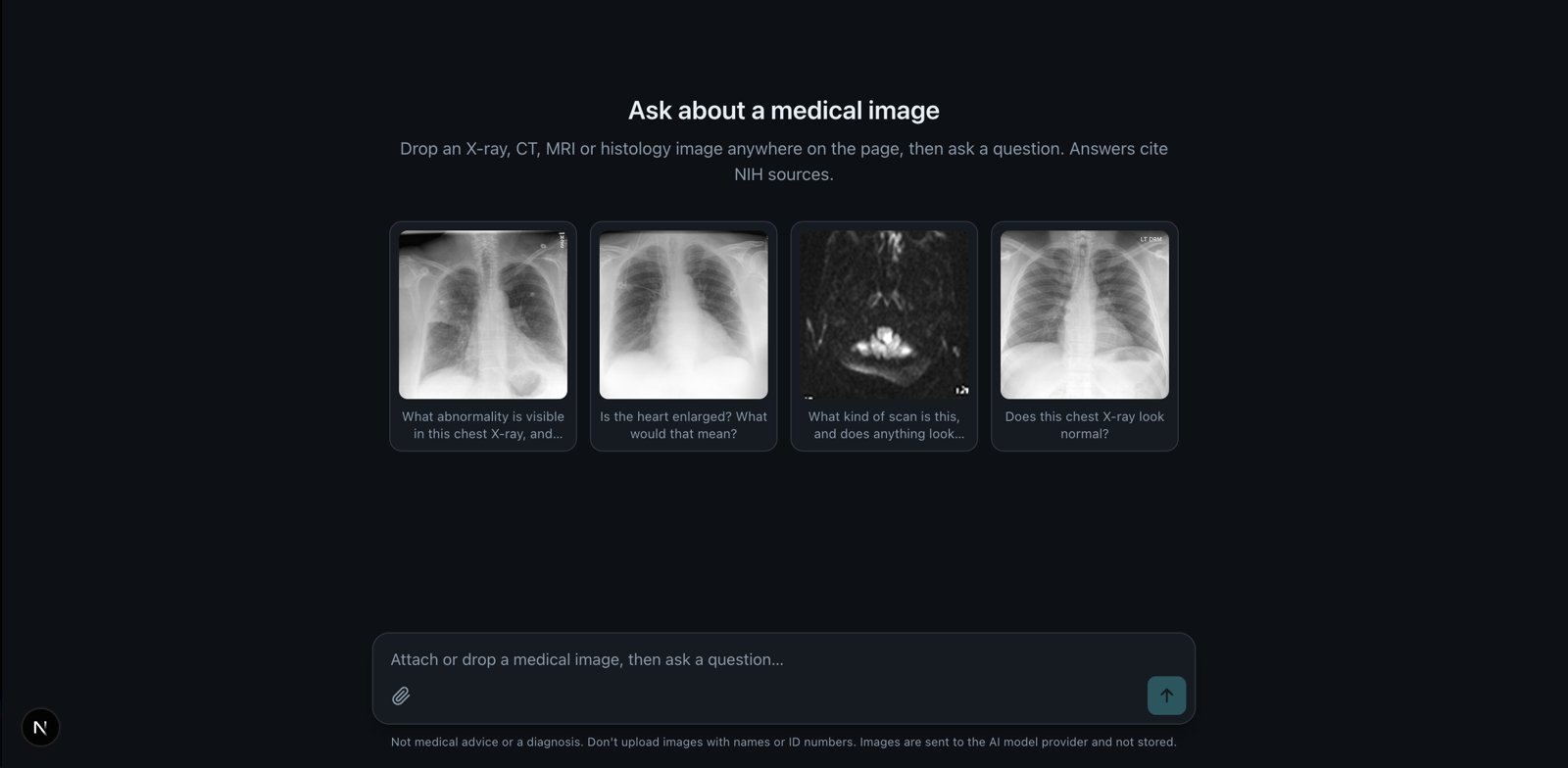
Med-VQA answers questions about medical images in plain language. You upload a scan, ask something like "is anything wrong?" or "is the heart enlarged?", and get a short, conversational answer. Each medical claim links to the NIH page it came from, and chest X-rays also come with the most similar real cases from a public archive of radiology reports. It was built in about a day at Knight Hacks 2026 with Evanton, who built the web frontend.
Try Med-VQA →WRIVA CVGL CHALLENGE
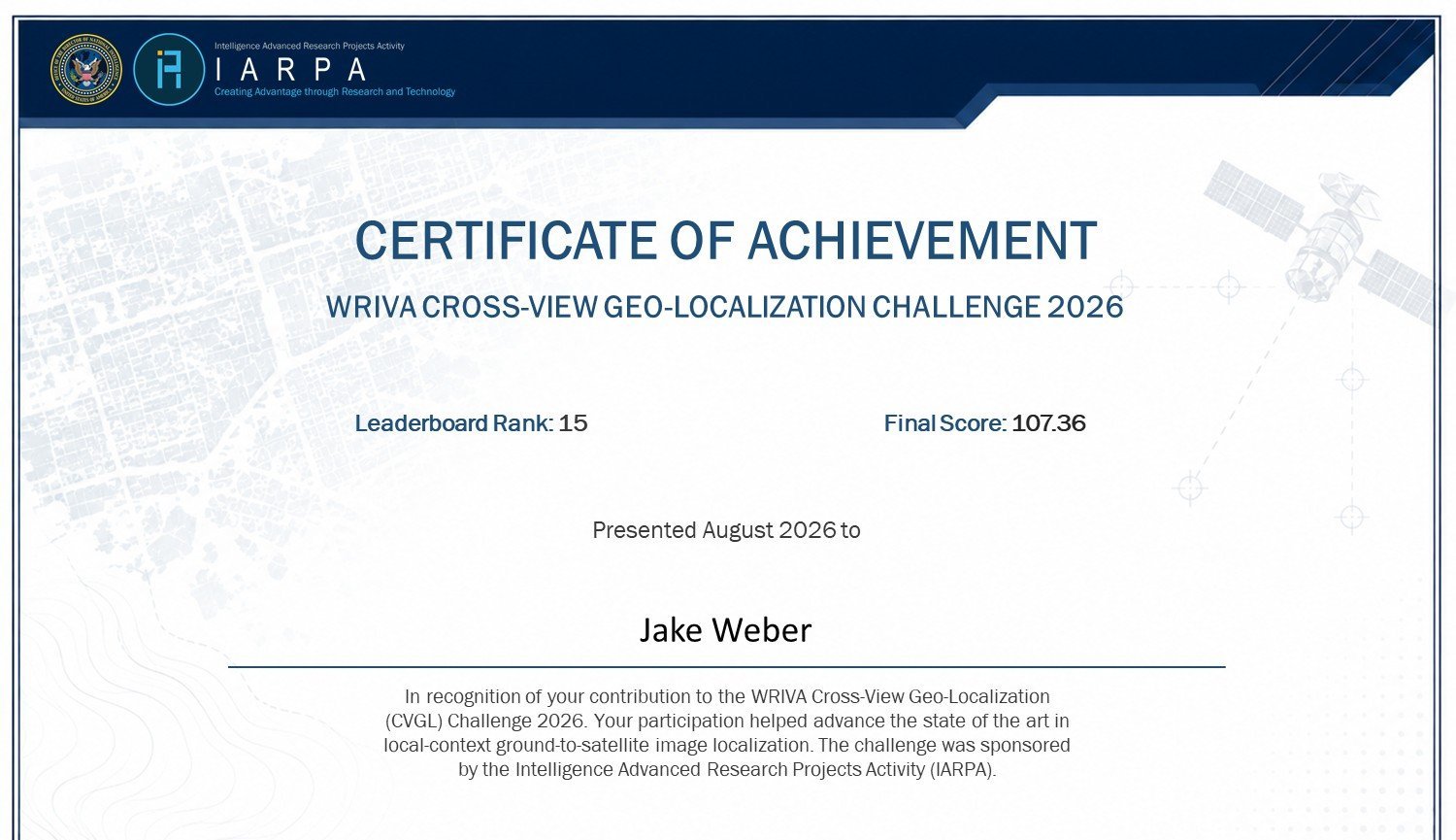
Cross-view geo-localization means working out where a ground-level photo was taken by matching it against overhead satellite imagery. In IARPA's 2026 WRIVA CVGL Challenge, systems received sequences of ground camera frames and had to predict each frame's latitude, longitude, heading and pitch on Maxar satellite GeoTIFFs, including on test sites whose data differed from training. I competed solo and finished 15th globally with a final score of 107.36, recognized by an IARPA certificate of achievement.
View project →AUTONOMOUS DRONE
A simulated quadrotor that runs a complete mission profile while reacting in real time to its sensors. It's a testbed for flight-control logic that will later move to a real flight controller (an STM32 target). Each part (perception, control, motor mixing) is its own ROS 2 node, so pieces can be swapped or tested independently.
View project →LORA NUCLEI SEGMENTATION
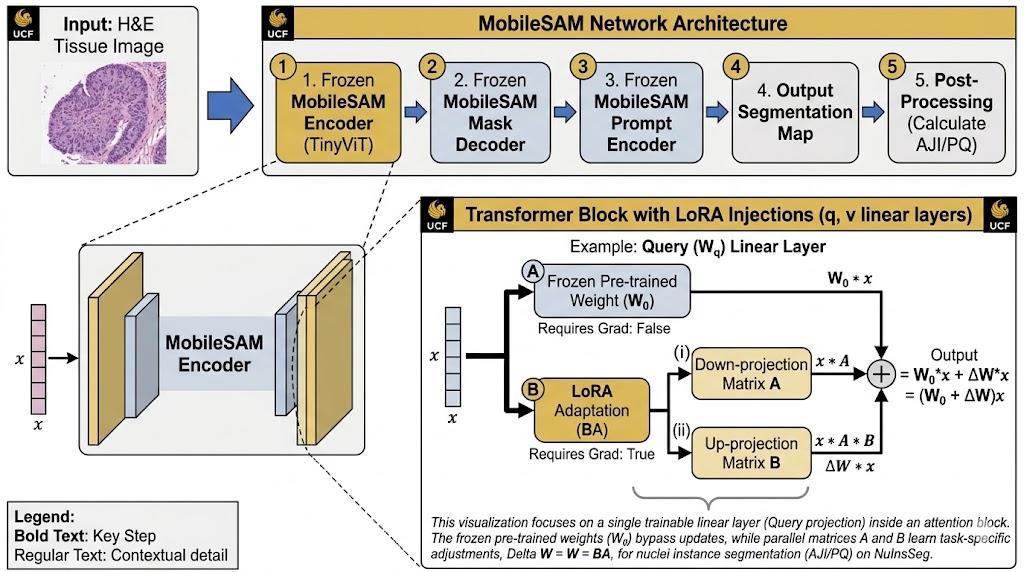
Counting and outlining cell nuclei in H&E-stained tissue is a basic step in computational pathology: nuclear density, size and shape variation all carry diagnostic signal. Segment Anything (SAM) models segment well in general but aren't trained on histology. They also usually need a human to click or draw boxes. This project adapts MobileSAM, a lightweight SAM variant with a TinyViT image encoder, to nuclei without prompts and while training almost nothing.
View project →DIFFUSION VIRTUAL STAINING
Pathologists stain breast-cancer tissue twice: once with routine H&E, and again with immunohistochemistry (IHC) to score HER2 expression, which guides treatment. Virtual staining tries to predict the IHC image directly from the H&E slide, saving time, tissue and lab cost. This study asks which diffusion-model design choices close the gap with established GAN baselines on the BCI-512 benchmark.
View project →FSI LUNAR ROVER MOTOR DRIVE
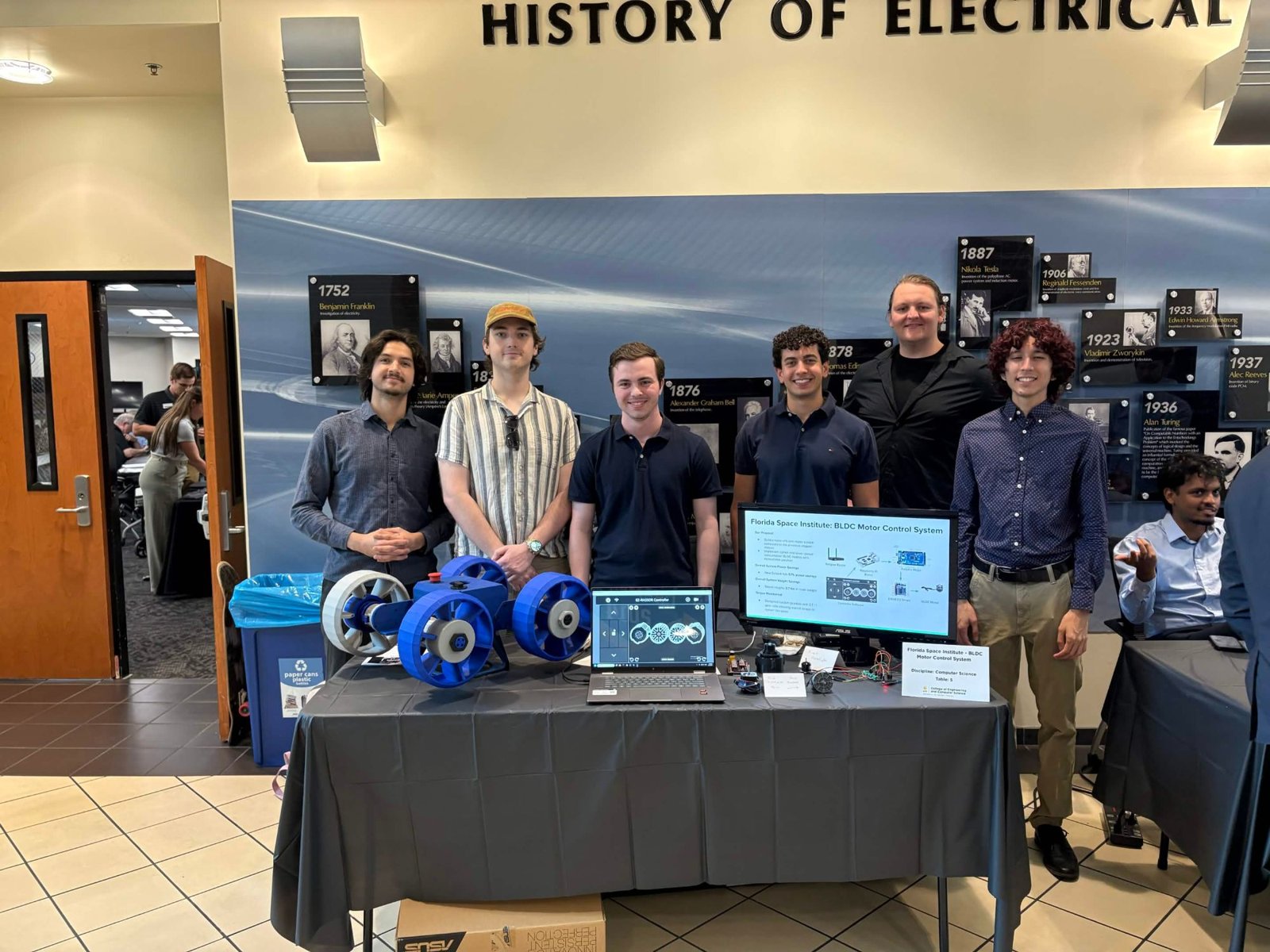
RE-RASSOR (Research and Education Regolith Advanced Surface Systems Operation Robot) is a 3D-printed variant of NASA's RASSOR lunar excavation rover, used by the Florida Space Institute for research and education. Its original stepper-motor drivetrain was heavy and power-hungry. Our six-person UCF senior design team, sponsored by FSI with faculty mentors Mike Conroy and Christian Vincent, designed a new brushless (BLDC) motor control system to replace it.
View project →Contributors:
- Jake Weber
- Noah Fourari
- Alex Fowler
- Nicholas Bernhoft
- Gabriel Pullam
- Kenneth Arias